Enterprise CMMS for Multi-Location Facilities: Governance, Visibility, and Control
An expert's guide to enterprise CMMS for multi-location facilities, focusing on governance, visibility, and control to overcome maintenance chaos.
MaintainNow Team
February 14, 2026
Introduction
The phone rings. It’s the regional director for the Northeast. A critical chiller at the Philadelphia manufacturing plant has failed—again. The local team is scrambling, but they don't have the part, can't find the service history, and the senior tech who knew that unit "like the back of his hand" retired six months ago. Meanwhile, another call comes in. The fire marshal is doing a surprise inspection at a retail location in Chicago and is asking for compliance documentation on the sprinkler system that nobody can seem to locate.
It’s a familiar story for anyone managing maintenance across a distributed portfolio of facilities. The chaos is constant. Each location becomes its own silo, a tiny kingdom with its own processes, its own spreadsheets (if you’re lucky), and its own approach to asset management. One site runs to failure, another over-engineers its preventive maintenance program, and a third relies entirely on the institutional knowledge locked in a few key technicians' heads.
Trying to get a clear picture of the entire operation feels impossible. You're flying blind. What is the total maintenance spend? Which asset class is costing the most in unplanned downtime? Are we meeting our service level agreements? The data, if it exists at all, is fragmented, inconsistent, and untrustworthy. It's a classic case of death by a thousand spreadsheets. This operational disconnect isn't just inefficient; it's a massive strategic risk. It hamstrings growth, inflates costs, and leaves the organization dangerously exposed to equipment failure and regulatory penalties. The challenge isn't just about fixing things that break. It’s about building a scalable, repeatable, and transparent maintenance ecosystem that supports the enterprise's goals.
This is where the conversation shifts from a simple CMMS to an Enterprise CMMS strategy. It’s a fundamental change in thinking—moving from a site-level tool for managing work orders to a corporate-level platform for governance, visibility, and control over the entire asset portfolio.
The Governance Gap: Taming the Operational Hydra
In a multi-location enterprise, the lack of standardized governance is the root of most maintenance evils. Without a central framework, each facility operates in a vacuum. This operational fragmentation creates a hydra-headed monster that's impossible to manage effectively.
The Standardization Struggle
One of the most significant challenges is the lack of a unified asset hierarchy. The Boston office might log a rooftop HVAC unit as "RTU-01," while the Dallas facility calls an identical piece of equipment "AC-MAIN-ROOF." This simple inconsistency makes it impossible to perform any meaningful analysis. Organizations can't compare the performance of similar assets, can't track lifecycle costs accurately, and can't develop standardized preventive maintenance plans. Trying to roll up data for an executive report becomes a nightmare of manual data cleansing, guesswork, and ultimately, flawed conclusions.
The same problem plagues work management. Different sites use different priority codes, different status updates, and different problem-cause-remedy codes. A "High Priority" task in one location might be a "P1 - Critical" in another. How can a central operations team allocate resources or identify systemic issues when the language itself is inconsistent? The answer is, they can't. They're stuck in a reactive loop, dealing with the loudest emergency rather than the most strategic need.
This is where a true enterprise CMMS begins to show its value. It's not just software; it's an enforcement mechanism for corporate standards. A well-implemented system, like the platform at MaintainNow (https://maintainnow.app), forces the creation of a single, non-negotiable asset hierarchy. Every asset, from a massive industrial chiller to a simple fire extinguisher, is categorized and tagged according to a corporate standard. This creates a single source of truth for the entire asset portfolio.
With this foundation, organizations can build standardized PM templates, safety procedures, and work order workflows that are deployed across every single location. A preventive maintenance task for a specific model of air handler is the same in Seattle as it is in Miami. This ensures consistency, simplifies technician training, and, most importantly, generates clean, comparable data. Suddenly, it becomes possible to benchmark facilities against each other, identify best practices from high-performing sites, and replicate them across the enterprise.
Centralized Control, Local Execution
Governance isn't about micromanagement. It's about providing a framework within which local teams can excel. An enterprise CMMS should allow for centralized control over key parameters while giving local teams the flexibility they need to operate effectively.
For instance, corporate maintenance engineering can define the core PM schedules and safety requirements for critical assets. These become non-negotiable. However, the local facility manager should still have the ability to schedule the work around production schedules, assign specific technicians, and add notes relevant to their site. This hybrid model provides the best of both worlds: corporate oversight and compliance with local operational autonomy.
Modern systems enable this through sophisticated role-based permissions. A corporate reliability engineer might have the ability to create and modify asset strategies globally, while a site-level supervisor can only manage work orders and technicians within their own facility. A regional manager gets a dashboard view of all their sites, allowing them to monitor KPIs without getting bogged down in the day-to-day execution. This granular control ensures that everyone has access to the information they need—and only the information they need—to do their job effectively. It’s about building guardrails, not cages.
The Visibility Black Hole: From Data Graveyards to Actionable Intelligence
If governance provides the framework, visibility provides the intelligence. Without a unified view of maintenance operations, facility leaders are effectively managing a multi-million-dollar portfolio based on anecdotes and gut feelings. Spreadsheets become data graveyards—repositories of information that are never analyzed, never trended, and never used to make strategic decisions.
A Single Pane of Glass
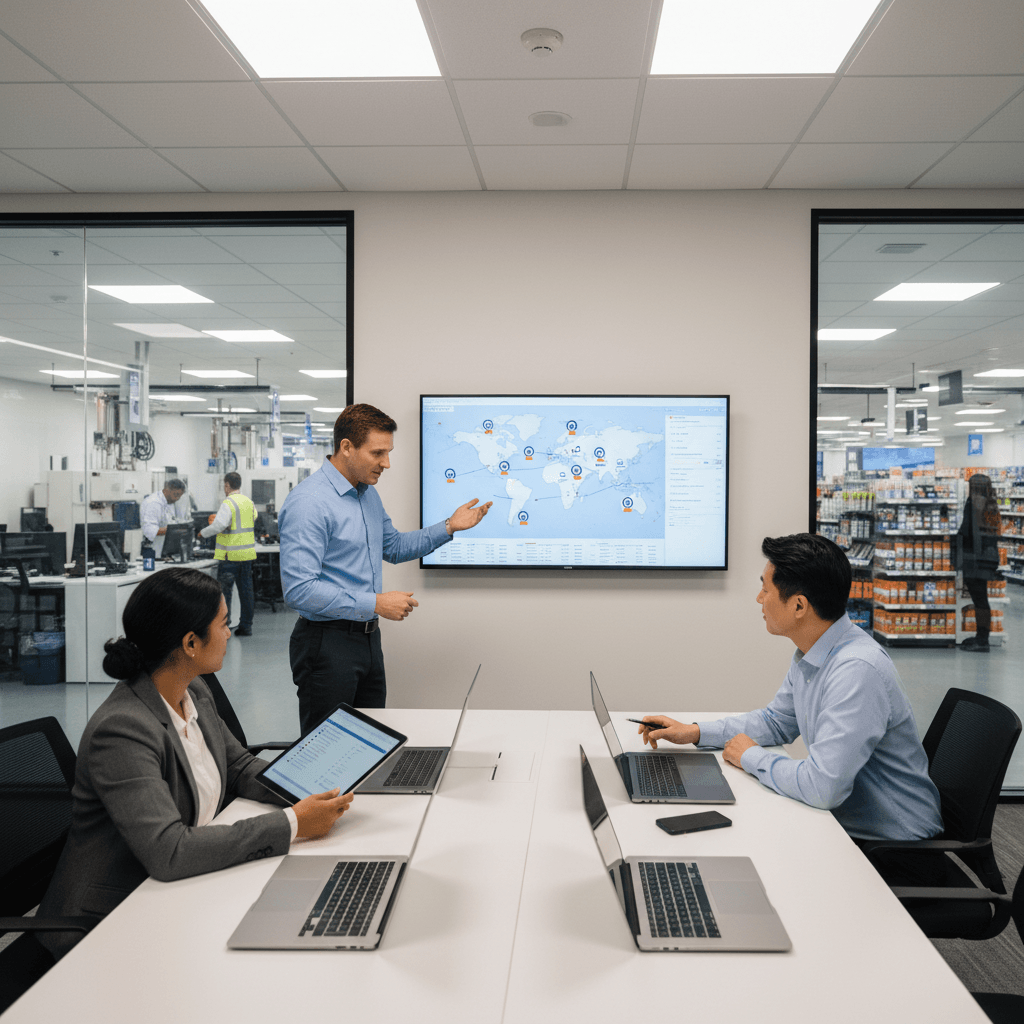
The most immediate benefit of an enterprise CMMS is the consolidation of data into a single, accessible platform. Imagine being able to pull up a dashboard that shows, in real-time, the health of your entire portfolio. Key performance indicators (KPIs) like PM compliance, Mean Time to Repair (MTTR), and wrench time are no longer month-end reporting exercises; they are live metrics that can be monitored daily.
This "single pane of glass" view is transformative. A maintenance director can instantly see which region is struggling with backlog, which facility has an unusually high rate of reactive maintenance, or which asset class is consuming the majority of the MRO budget. The conversation shifts from "I think we have a problem with our conveyor systems" to "Data shows our West Coast distribution centers have a 30% lower Mean Time Between Failures (MTBF) on their conveyors compared to the East Coast. Let's investigate why."
This level of visibility extends all the way to the executive suite. When a COO asks about asset reliability, the answer isn't a week-long scramble to collate spreadsheets. It's a direct, data-backed report pulled from the CMMS in minutes. This ability to provide accurate, timely information builds confidence and makes the maintenance department a strategic partner in the business, not just a cost center. Platforms designed for this level of reporting, like those accessible through app.maintainnow.app, make this transition from anecdotal to data-driven management a reality for enterprise teams.
Unlocking Advanced Maintenance Strategies
True visibility goes beyond reactive dashboards. It's the foundation for more advanced, proactive maintenance strategies. Once an organization has a clean, centralized, and consistent stream of data, it can begin to move up the maintenance maturity curve.
Preventive maintenance (PM) optimization becomes possible. Instead of relying on generic OEM recommendations, teams can analyze the actual failure history of their assets. Is a quarterly PM on a certain pump model preventing failures, or is it just creating unnecessary work and potential for human error? By analyzing work order history across hundreds of similar assets, reliability engineers can fine-tune PM frequencies, saving countless labor hours and reducing the risk of infant mortality in components.
This is also where the journey toward predictive maintenance (PdM) begins. An enterprise CMMS acts as the central hub for all asset-related data, including inputs from condition monitoring sensors. Vibration analysis, thermal imaging, oil analysis, and IoT sensor data can be fed into the system and associated with specific assets. When a sensor on a critical motor detects an anomaly—an increase in vibration or a temperature spike—it can automatically trigger a work order in the CMMS.
This isn't science fiction anymore. It's a practical reality for organizations with the right data infrastructure. Instead of waiting for the motor to fail and shut down a production line, the system flags the issue early. A technician is dispatched to investigate, finds a worn bearing, and replaces it during a planned shutdown. The catastrophic failure is averted. The savings, both in direct repair costs and avoided downtime, can be colossal. This proactive approach is simply impossible without a centralized system to collect, analyze, and act on the data from across the enterprise.
The Control Conundrum: Ensuring Compliance and Optimizing Spend
Governance provides the rules and visibility provides the insight, but control is about execution. It's about ensuring that the right work is done, the right way, at the right time, and at the right cost—every single time, across every single facility. In a distributed environment, maintaining this level of control is a monumental challenge.
Enforcing Compliance and Mitigating Risk
Regulatory and safety compliance is a non-negotiable aspect of facility management. From OSHA's lockout/tagout procedures to EPA regulations on refrigerant handling, the potential for penalties, fines, and reputational damage is enormous. In a multi-location setup, how can an organization be certain that every site is adhering to these critical standards?
"Pencil whipping"—the act of signing off on a task without actually performing it—is a terrifyingly common reality when oversight is weak. An enterprise CMMS provides powerful tools to enforce compliance and create an auditable trail.
Digital checklists and standardized job plans can be built directly into work orders. A technician performing a critical safety inspection on a fire suppression system must digitally sign off on each step. They can be required to attach photos, record measurements, and confirm safety procedures before they can close out the work order. This creates a detailed, time-stamped record of exactly what was done, by whom, and when.
When the fire marshal arrives for that surprise inspection, the facility manager doesn't need to dig through a dusty filing cabinet. They can simply pull up the asset's history on a tablet via a mobile CMMS application. Every inspection, every repair, and every piece of compliance documentation is right there. This ability to instantly produce evidence of due diligence is invaluable. It transforms a high-stress, high-risk audit into a routine, transparent process.
Getting a Handle on MRO Spend
Maintenance, Repair, and Operations (MRO) inventory and purchasing is another area where lack of control leads to massive inefficiency and waste. When each site manages its own storeroom and its own vendors, chaos ensues. One facility might have a surplus of critical motors gathering dust, while another site pays for expedited shipping for the exact same part. Redundant inventory ties up capital, and decentralized purchasing prevents the organization from leveraging its scale to negotiate better prices with vendors.
An enterprise CMMS with integrated MRO inventory management brings this chaos under control. It allows for a global view of inventory across all locations. Before a technician at one site orders a new part, the system can check for available stock at other nearby facilities. This simple cross-leveling of inventory can save millions of dollars annually in unnecessary purchases and shipping costs.
Furthermore, it centralizes control over purchasing and vendor management. The system can enforce the use of preferred vendors, pre-negotiated contracts, and standardized approval workflows for purchases over a certain threshold. This ensures that the organization is maximizing its buying power and eliminates the "maverick spending" that plagues so many large companies. The result is a leaner, more efficient supply chain and a significant reduction in overall maintenance costs. Control isn't just about risk mitigation; it's a powerful lever for financial optimization.
Conclusion
The transition from managing facilities to strategically managing an enterprise asset portfolio is one of the most critical challenges facing multi-location organizations today. The old model of fragmented operations, data silos, and localized decision-making is no longer sustainable. It's too slow, too expensive, and far too risky in a competitive landscape where operational excellence is paramount.
Implementing an enterprise CMMS is not merely a software upgrade. It is a fundamental operational transformation. It’s about establishing a culture of standardization through robust governance. It’s about replacing guesswork with data-driven strategy through enterprise-wide visibility. And it’s about ensuring consistent, compliant, and cost-effective execution through centralized control.
This unified approach breaks down the silos that have traditionally hampered performance. It allows the organization to leverage its scale, share best practices, mitigate risks systematically, and make informed capital investment decisions based on a complete understanding of the asset lifecycle. The maintenance function evolves from a perpetual state of firefighting to a proactive, strategic driver of business value. The conversation changes from "What broke?" to "How can we prevent it from ever breaking again?" That is the power and the promise of a true enterprise maintenance management strategy. For organizations ready to make that leap, platforms like MaintainNow provide the foundational technology to turn that vision into a tangible reality.
Ready to implement these maintenance strategies?
See how MaintainNow CMMS can help you achieve these results and transform your maintenance operations.
Download the Mobile App:


✅ No credit card required • ✅ 30-day money-back guarantee • ✅ Setup in under 24 hours