The Real Cost of Poor Asset Tracking—and How CMMS Solves It
Explore the hidden financial and operational costs of inadequate asset tracking in facility maintenance and discover how a modern CMMS provides the visibility and control needed to turn chaos into strategic advantage.
MaintainNow Team
February 14, 2026
Introduction
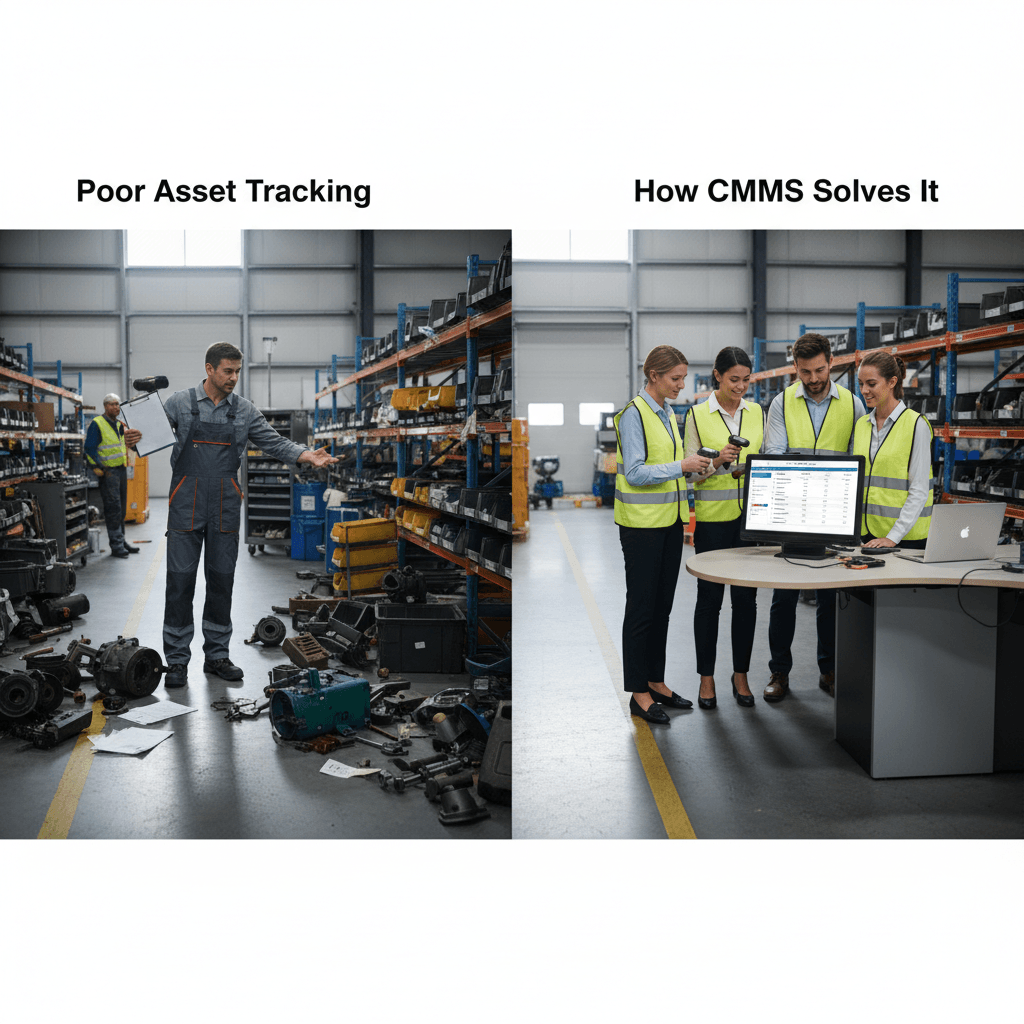
It’s 2:00 AM on a Tuesday. The phone rings, and a facility manager’s heart sinks. It’s the call every maintenance professional dreads: a critical production line is down. The culprit is a failed motor on a conveyor system, but that’s all the night shift operator can tell you. The search begins. Which motor is it, exactly? When was it last serviced? Is there a spare in stock? Where are the warranty documents? The team scrambles, digging through disorganized binders and outdated spreadsheets while costly downtime ticks by, minute by agonizing minute.
This scenario isn't a hypothetical worst-case. It's the operational reality for thousands of maintenance teams still grappling with inadequate asset management. The problem is a fundamental lack of visibility—a kind of operational blindness where the true state, location, and history of critical equipment are obscured. This isn't just an inconvenience; it's a profound and continuous drain on resources, budget, and morale.
Many organizations underestimate the true cost of poor asset tracking. They see the price of a failed component or the overtime paid to a technician, but they miss the cascading financial impacts that ripple through the entire operation. It’s a death by a thousand cuts: lost production, wasted labor, inflated inventory costs, premature asset failure, and compromised safety. The absence of a centralized, reliable system for managing physical assets forces teams into a perpetual state of reactive firefighting. They are always a step behind, patching problems instead of preventing them.
This is the gap that modern maintenance management was designed to fill. A Computerized Maintenance Management System (CMMS) is more than just a digital logbook; it’s the central nervous system for a facility’s maintenance operations. It provides a single source of truth, transforming ambiguous, chaotic data into actionable intelligence. By understanding the real, multi-faceted costs of poor tracking, the business case for implementing a robust CMMS becomes not just compelling, but undeniable.
The Financial Bleed: Unpacking the Hidden Costs of Invisibility
The costs associated with poor asset management are rarely isolated line items on a budget report. They are insidious, weaving their way into nearly every facet of operations. Without a clear picture of what you own, where it is, and what condition it's in, financial leakage is not a risk—it's a certainty.
The Specter of Ghost and Zombie Assets
In the world of accounting and maintenance, not all assets are what they seem. "Ghost assets" are pieces of equipment that appear on financial ledgers but are physically missing, stolen, or have been decommissioned without proper record-keeping. Organizations continue to pay taxes and insurance premiums on these non-existent assets, a direct and completely unnecessary financial drain. Industry data suggests that ghost assets can account for 10-25% of a company’s fixed-asset register, representing a significant source of wasted capital.
Conversely, "zombie assets" are the ones that are physically present but no longer in service. An old, retired chiller sitting in a back corner, a decommissioned air handler still occupying valuable space on a roof—these assets clutter facilities, complicate audits, and can even pose safety risks. Without a formal asset tracking and disposal process managed through a CMMS, these zombies linger, distorting the true picture of an organization’s operational footprint.
The Vicious Cycle of Reactive Maintenance
When asset tracking is weak, a preventive maintenance (PM) program is built on guesswork. If you don't have accurate data on an asset's age, usage hours, or maintenance history, you can't schedule PMs effectively. The result is an almost complete reliance on a "run-to-failure" maintenance strategy. While seemingly cheaper in the short term (you're not spending money on maintenance until something breaks), this approach is monumentally more expensive over the asset's lifecycle.
Emergency repairs are, by nature, chaotic and costly. They often involve paying premium rates for expedited parts, calling in technicians on overtime, and dealing with the collateral damage of a catastrophic failure. Studies consistently show that planned, preventive maintenance costs anywhere from three to nine times less than reactive maintenance. Poor tracking locks a maintenance team into the most expensive service model possible. Every unlogged repair, every missed PM, every undocumented component swap deepens this reactive spiral, making it harder and harder to escape. The work orders become a relentless stream of urgent, high-stress tasks, leaving no time for the strategic work that actually improves reliability.
The Crippling Cost of Extended Downtime
For any facility—be it a manufacturing plant, a hospital, a data center, or a commercial office building—downtime is the ultimate enemy. The cost of an idle production line can run into tens of thousands of dollars per hour. For a critical healthcare facility, it can have life-or-death consequences.
Poor asset tracking directly inflates this cost by extending the Mean Time to Repair (MTTR). When a critical asset fails, the clock starts ticking. Without a CMMS, the diagnostic and repair process is fraught with delays:
* Locating the Asset: Is the failed pump P-101A or P-101B? In a complex facility, just physically identifying the correct asset can waste precious time.
* Accessing Information: Where is the manual? What were the pressure readings last week? Who worked on it last? Without a centralized asset record, this information is scattered across paper files, different technicians' memories, or is simply lost.
* Sourcing Parts: Does the team know the exact part number for the failed bearing? Is it in stock? If so, where is it in the storeroom? A lack of linkage between assets and spare parts inventory turns a simple part retrieval into a frustrating treasure hunt.
Each of these small delays compounds, turning a one-hour repair into a four-hour outage. A CMMS eliminates these bottlenecks. A technician can scan a QR code on the asset and instantly access its entire history, including manuals, schematics, previous work orders, and a list of required spare parts. This immediate access to information is the key to slashing MTTR and minimizing the crippling financial impact of downtime.
The Dual Threat of Inventory Bloat and Stockouts
Effective inventory control is impossible without effective asset tracking. The two are inextricably linked. When a maintenance team doesn't have confidence in their asset data, they can't accurately forecast spare parts needs. This leads to two costly extremes.
The first is inventory bloat. To avoid being caught empty-handed during an emergency, teams often overstock critical spares. "Just in case" becomes the default strategy. This ties up a tremendous amount of capital in parts that may sit on a shelf for years, eventually becoming obsolete. It also consumes valuable physical space and requires labor to manage.
The second, and often more damaging, problem is a stockout. An asset fails, the technician identifies the needed part, but the storeroom is empty. The repair is now completely stalled until a new part can be sourced and delivered, often with expensive rush shipping fees. All the while, the asset remains down. A CMMS with robust inventory control modules connects the dots. It links specific parts to specific assets, tracks consumption rates, and can even automatically trigger reorder points when stock levels fall. This data-driven approach ensures the right part is available at the right time, without tying up unnecessary capital in excess inventory.
The CMMS as the Foundation for Operational Intelligence
Implementing a CMMS is not about adding another layer of software; it's about fundamentally changing how a maintenance organization sees and interacts with its physical world. It replaces ambiguity with clarity, creating a single source of truth that becomes the bedrock for all maintenance activities. A modern, accessible system, like the platform offered by MaintainNow, transforms scattered data points into a cohesive, intelligent operational picture.
Building the Digital Twin: From Lists to Living Models
At its core, a CMMS allows a facility to build a "digital twin" of its asset portfolio. This isn't just a flat list of equipment in a spreadsheet. It’s a dynamic, hierarchical representation of the entire facility. Think of it as a family tree for your assets. You can structure it logically: Site > Building > Floor > System (e.g., HVAC) > Asset (e.g., Air Handling Unit AHU-04) > Component (e.g., Fan Motor).
This hierarchical structure is incredibly powerful. It provides context. When a work order is generated for that fan motor, everyone on the team immediately understands its location and its role within the larger HVAC system. This clarity is the first step in moving away from chaotic, ad-hoc repairs toward a structured, methodical approach to maintenance. Tools like MaintainNow make this process intuitive, allowing teams to build out their asset database quickly and logically, often using mobile maintenance devices right on the facility floor.
The Power of Centralized, Dynamic Data
The fatal flaw of manual tracking systems—whether they're spreadsheets, whiteboards, or three-ring binders—is that they are static and siloed. They are prone to human error, difficult to update, and almost impossible to access remotely. (And let's be honest, that spreadsheet on the shared drive is rarely as up-to-date as it needs to be).
A CMMS centralizes all asset-related information into one accessible, secure database. This includes:
* Asset Specifications: Make, model, serial number, installation date, warranty information.
* Maintenance History: A complete, searchable log of every work order—every PM, every repair, every inspection—ever performed on that asset.
* Associated Documents: Manuals, schematics, safety procedures, and photographs are attached directly to the asset record.
* Meter Readings: Data on run hours, cycle counts, or other condition-based metrics.
* Parts Information: A list of critical spare parts associated with the asset.
Because this data is dynamic and updated in real-time, it becomes a living history. A technician in the field can pull up the record for a 20-year-old boiler and see a complete log of its life, giving them invaluable context for troubleshooting a new problem. This institutional knowledge is no longer trapped in the head of a senior technician; it’s captured and preserved within the system for the entire team to leverage.
Connecting Work Orders to Assets: Creating Actionable History
This is where the system truly comes to life. A CMMS transforms work orders from simple to-do lists into rich data-gathering events. Every time a work order is created, executed, and closed out, it is permanently linked to the specific asset it was performed on.
Over time, this creates an incredibly valuable dataset. A facility manager can look at the history of an asset and see patterns emerge. Is a particular pump failing every six months? Perhaps the PM frequency needs to be adjusted, or maybe it’s time to investigate a root cause. Are multiple assets of the same model experiencing similar failures? This could point to a design flaw or an operational issue that needs to be addressed system-wide.
Without this direct link between work orders and assets, this kind of analysis is impossible. The data exists, but it's disconnected noise. A CMMS provides the structure to turn that noise into a clear signal, enabling managers to move from reactive problem-solving to proactive, data-driven reliability improvement.
From Theory to Practice: Leveraging a CMMS for Strategic Advantage
Once a solid foundation of asset tracking is established within a CMMS, it unlocks a host of advanced maintenance strategies that were previously out of reach. It enables the shift from a cost center focused on repairs to a strategic department focused on asset performance, lifecycle management, and operational excellence.
Fine-Tuning Preventive and Predictive Maintenance
A generic, calendar-based PM program is better than nothing, but it's far from optimal. It often leads to over-maintenance on some assets (performing service before it's needed, which wastes labor and materials) and under-maintenance on others (allowing them to fail before a scheduled PM).
With the rich data captured in a CMMS, organizations can evolve their strategies.
* Usage-Based PMs: Instead of servicing a backup generator every three months, the CMMS can trigger a work order after every 100 run hours. This bases maintenance on actual usage, not an arbitrary date on the calendar.
* Condition-Based Maintenance (CBM): By tracking metrics like vibration, temperature, or pressure readings, the CMMS can trigger alerts when a reading falls outside of normal operating parameters. This allows teams to intervene *before* a failure occurs, catching problems in their infancy when they are cheaper and easier to fix.
This level of sophistication is the gateway to true predictive maintenance (PdM), where data trends are used to predict failures with a high degree of accuracy. This journey begins with the simple, fundamental act of accurately tracking asset data in a centralized system.
Empowering the Front Lines with Mobile Maintenance
The single greatest revolution in maintenance management over the past decade has been the rise of mobile maintenance. The days of technicians starting their shift at a desktop computer, printing a stack of paper work orders, and returning at the end of the day to type up their notes are over.
Modern CMMS platforms are built around mobile-first functionality. A technician armed with a smartphone or tablet running an application like the one available at `https://www.app.maintainnow.app/` has the full power of the CMMS in their pocket. This untethers them from the office and dramatically increases "wrench time"—the amount of time they spend actively working on equipment.
Out on the floor, a tech can scan a QR code or NFC tag affixed to an asset to instantly:
* Pull up the asset’s full history and documentation.
* View all open work orders associated with that asset.
* Log their time and notes directly into the work order in real-time.
* Look up and reserve spare parts from inventory control.
* Attach photos of the problem and the completed repair.
* Close out the work order the moment the job is finished.
This immediate, on-location data capture improves the accuracy and timeliness of maintenance records exponentially. It eliminates the delay and potential errors of transcribing handwritten notes, and it provides managers with a real-time view of work-in-progress across the entire facility.
Data-Driven Capital Planning and Lifecycle Costing
Effective asset tracking extends far beyond day-to-day maintenance. It is a critical input for long-term financial planning. When a CMMS diligently tracks every cost associated with an asset—including parts, labor, and the cost of downtime—it becomes possible to calculate the Total Cost of Ownership (TCO).
This data is invaluable when making repair-or-replace decisions. The maintenance director can go to the finance department with a clear, data-backed case. For example: "This 15-year-old air compressor has cost us $25,000 in emergency repairs and caused 40 hours of production downtime in the last 18 months. Its TCO is now exceeding its planned lifecycle cost. A new, more efficient model will cost $50,000, but it will have a payback period of less than three years through reduced energy and maintenance costs."
This transforms the maintenance department from a team that simply asks for money to fix broken things into a strategic partner that uses data to optimize capital expenditures and maximize asset performance over the long term. This is the essence of true Enterprise Asset Management (EAM), and it all starts with tracking every asset and every work order in a unified system.
Conclusion
The consequences of poor asset tracking are far more significant than a few misplaced tools or a forgotten service date. It creates a state of operational fog that leads to wasted capital, excessive downtime, bloated inventory, and a maintenance team that is perpetually stressed and reactive. The costs are real, they are substantial, and they accumulate every single day that a facility operates without a clear, centralized view of its physical assets.
A modern CMMS is the instrument that cuts through this fog. It is not merely a piece of software to be installed, but a foundational business system that enables visibility, control, and intelligence. By creating a single, reliable source of truth for every asset, it empowers maintenance teams to move beyond the chaotic cycle of run-to-failure. It provides the framework for optimizing preventive maintenance, streamlining work orders, controlling inventory, and making sound, data-driven decisions about the entire asset lifecycle.
The transition from spreadsheets and binders to a comprehensive maintenance management platform like MaintainNow is a transition from tactical firefighting to strategic asset management. It's about giving talented maintenance professionals the tools they need to do their best work, protecting the organization's most valuable physical investments, and transforming the maintenance department into a proven driver of reliability, efficiency, and profitability. The real cost of poor tracking is the opportunity cost of not operating at this level.
Ready to implement these maintenance strategies?
See how MaintainNow CMMS can help you achieve these results and transform your maintenance operations.
Download the Mobile App:


✅ No credit card required • ✅ 30-day money-back guarantee • ✅ Setup in under 24 hours