Reducing Unplanned Downtime With Mobile Work Orders: What Changes When Technicians Ditch the Clipboard
Discover how replacing paper clipboards with mobile CMMS work orders cuts unplanned downtime, elevates wrench time, and accelerates facility reliability.
MaintainNow Team
October 27, 2026
Introduction
The physical clipboard has maintained an oddly resilient grip on maintenance departments for over half a century. Walk through an industrial manufacturing plant, a sprawling healthcare campus, or a multi-tenant commercial high-rise at seven in the morning, and the ritual remains remarkably consistent. A lead technician stands over a metal sorting tray or a wire basket, sifting through carbon-copy work tickets. Some tickets are stained with spindle oil or hydraulic fluid. Others feature handwriting so hurried and illegible that deciphering the reported symptom resembles an exercise in paleography rather than mechanical troubleshooting.
This paper-based workflow creates an invisible, compounding drag on plant operations. Between the moment a line operator spots an anomalous drip beneath a positive displacement pump and the moment a millwright actually unholsters a pipe wrench, hours slip away. Sometimes days. The paper order sits on a supervisor's desk awaiting triage. It waits for someone to cross-reference equipment tag numbers against an aging binder. It waits for a runner to deliver it to an outbuilding.
Meanwhile, the mechanical fault does not wait. Microscopic surface pitting on a spherical roller bearing steadily evolves into sub-surface spalling. Heat accumulates. Friction climbs. What began as a twelve-dollar seal replacement cascades into catastrophic shaft seizure, a scorched motor winding, and six hours of unscheduled production halt costing tens of thousands of dollars per hour.
Unplanned downtime rarely stems from a catastrophic failure that appeared out of thin air. In the vast majority of industrial and commercial environments, equipment failure is a long, slow conversation that the machinery tries to have with operations—a conversation silenced or delayed by the medium used to convey it. When maintenance teams retire the clipboard in favor of mobile CMMS software, the underlying dynamic of the entire facility changes. The transition is not simply about eliminating paper waste or appearing technologically progressive. It is an operational rewiring that attacks latency at its root, converting reactive firefighting into predictable, data-driven asset reliability.
The Anatomy of Latency: Why Paper Accelerates Unplanned Downtime
Every unexpected machine stoppage possesses a timeline, and that timeline is divided into distinct operational phases: detection, notification, triage, diagnosis, parts staging, repair, and commissioning. When facilities rely on paper clipboards, every single handoff along that sequence introduces friction and latency.
Consider detection and notification. An operator on a packaging line notices an unusual high-frequency squeal from an overhead conveyor drive. Under a legacy paper regime, the operator must finish their immediate run or wait for a scheduled break before walking across the building to the maintenance shop. If the shift supervisor is on the floor troubleshooting another issue, the paper request sits in an intake box. If the shift ends before that ticket is reviewed, the notification carries over into the next shift's briefing—if it does not slip between the desk and the filing cabinet first.
Industry data indicates that the average time between an operator noticing an initial equipment anomaly and a paper work order being formally generated ranges between four and twenty-four hours. In severe operating conditions—such as high-speed bottling lines or chemical processing environments—that latency window is often wider than the remaining operational lifespan of the failing component.
The Wrench Time Deficit
Wrench time—the actual proportion of a shift that a technician spends with tools on machinery completing maintenance tasks—remains one of the most revealing operational metrics in asset management. Across industrial sectors relying on paper work orders, wrench time hovers between twenty-five and thirty-five percent. Technicians do not spend the remaining sixty-five percent of their shifts resting. They spend it walking back and forth across facilities.
A technician finishes inspecting an air handler on the roof of a commercial property. They discover a shredded V-belt. With a paper clipboard, the sequence requires walking down three flights of stairs to the central maintenance office to log the defect. From there, the technician walks to the storeroom to check parts availability. If the belt is not in stock, they must consult a paper catalog or track down the procurement coordinator. Once the part is retrieved, they trek back up to the roof.
This administrative wandering destroys maintenance efficiency. It also breeds fatigue and frustration among skilled tradespeople who joined the profession to solve mechanical problems, not to serve as internal couriers. When paper dominates, the clipboard operates as a physical tether pulling technicians away from machinery and back toward the administrative desk.
The Diagnostic Black Hole
Paper work orders are notoriously context-poor. A typical ticket provides three lines of text: asset name, approximate location, and a generic problem description such as "conveyor making noise" or "pump leaking."
When the technician arrives at the asset with only a clipboard, they are blind to the operating context. When was this asset last greased? What grease specification was used—polyurea or lithium complex? Did the night shift adjust the motor drive parameters? What were the vibration readings during the last quarterly route? Has this specific failure mode occurred previously on this machine?
Without instant access to technical documentation, electrical schematics, or historical work logs, the technician is forced to spend critical hours conducting exploratory disassembly. They must walk back to the engineering archives to dig through grease-stained three-ring binders containing legacy OEM manuals. In many cases, critical maintenance decisions end up based on educated guesses rather than asset history, leading directly to repeat failures and extended Mean Time to Repair (MTTR).
Inventory Blind Spots and Stockout Disasters
Nothing halts a maintenance repair faster than a missing replacement part. Paper-based systems divorce work execution from inventory control.
When a technician takes a mechanical seal from the storeroom shelf, they are supposed to write the part number, quantity, and work order ID on a paper clipboard hanging near the storeroom door. In practice, during an emergency repair at two in the morning, this administrative step is easily forgotten. The inventory count in the system remains artificially elevated. The enterprise believes it has two spare seals on hand when, in truth, the shelf is bare.
Two weeks later, an identical pump suffers a seal failure. The on-duty crew rushes to the storeroom, discovers an empty bin, and the facility enters an emergency procurement spiral: hot-shot courier fees, exorbitant supplier expediting charges, and hours of preventable line downtime. Mobile systems close this loop by requiring inventory depletion directly at the point of work, transforming storeroom management from a theoretical exercise into an active, accurate feedback loop.
Operational Metamorphosis: The Floor Experience Under Mobile Work Orders
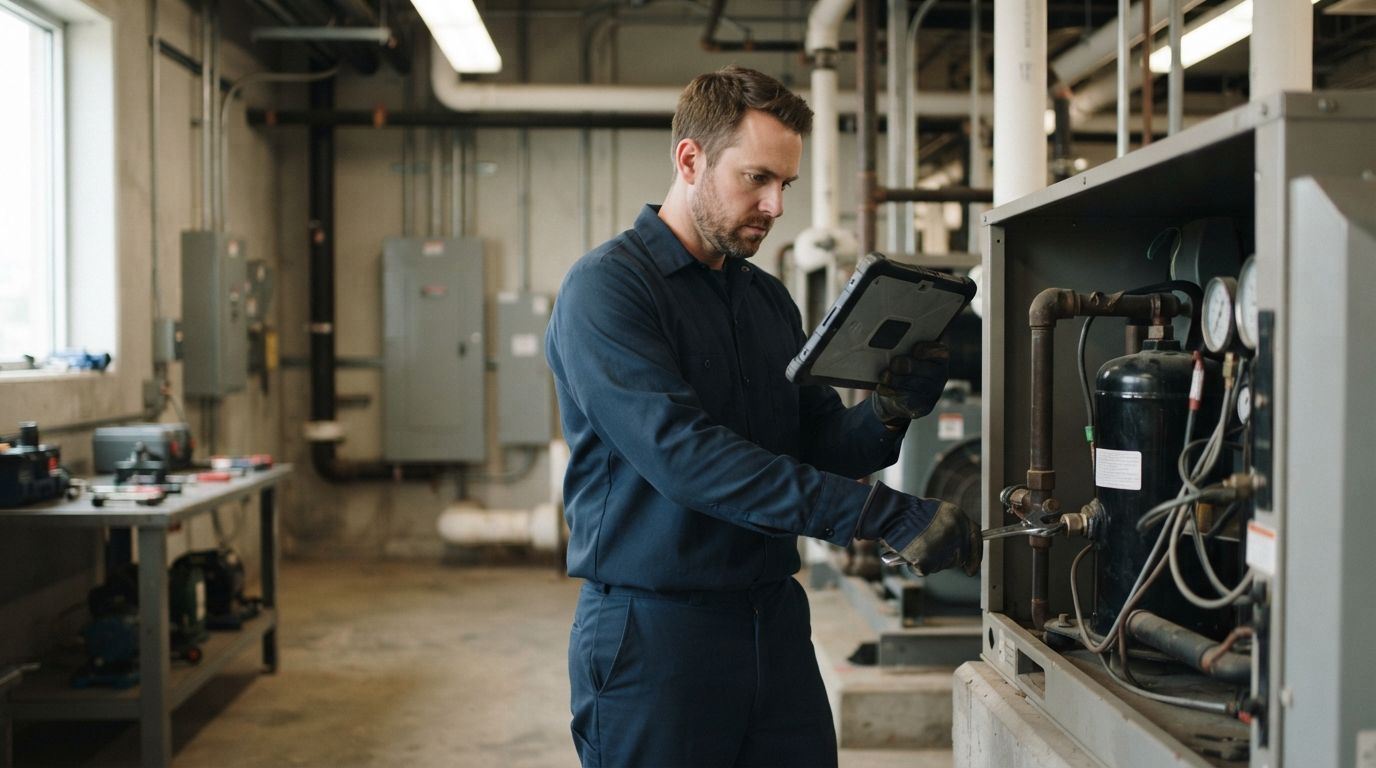
Eliminating the clipboard alters the physical rhythm of the maintenance department. Technicians equipped with native mobile applications on industrial tablets or smartphones interface with facility assets through a completely different paradigm. Instead of being passive recipients of daily paper stacks, they become agile nodes within an interconnected maintenance network.
Real-Time Dispatch and Intelligent Triage
When an anomaly is flagged in a digital environment—whether initiated by an operator, an automated line sensor, or a facility supervisor—the work request enters the system immediately. In platforms like MaintainNow, the request does not sit in a static queue. It is triaged based on predefined severity matrices and asset criticality rankings.
If an exhaust fan in an unoccupied storage warehouse trips its thermal overload, the request registers as a standard priority ticket. If a primary chilled water loop pump exhibits elevated bearing temperatures while the facility is in peak cooling demand, the system escalates the notification instantly.
Technicians operating on the floor receive targeted push notifications through mobile apps such as MaintainNow, containing all pertinent metadata: the exact asset location, the fault classification, the required personal protective equipment, and the standard operating procedures needed for isolation and lockout/tagout (LOTO). The delay between fault manifestation and technician dispatch collapses from hours to minutes.
Point-of-Work Documentation and Rich Media
Paper tickets accommodate only crude scribbles and abbreviated checkmarks. Mobile devices bring high-resolution cameras, audio recording, and barcode scanning directly to the asset face.
When a millwright tears down a gearbox and finds abnormal wear on the pinion teeth, they do not have to struggle to capture the nuance in writing. They take high-resolution macro photographs of the contact pattern, highlight the micropitting using native markup tools, and attach the images directly to the active work order. If a motor sounds abnormal, they can attach a short audio file capturing the specific frequency of the grinding noise.
This point-of-work documentation provides immense long-term value:
- It provides unambiguous technical records for warranty claims against component manufacturers.
- It enables senior reliability engineers or remote OEM specialists to inspect failure modes without physically traveling to the plant floor.
- It creates an indisputable visual record of asset condition before and after maintenance interventions, shielding the department during regulatory audits.
- It builds an institutional knowledge base that accelerates the onboarding of apprentice technicians facing identical failure modes in the future.
Furthermore, scanning an asset-mounted QR code or NFC tag guarantees technician presence at the asset. This simple verification virtually eliminates the pervasive industry problem of "ghost ticking"—the practice of sitting in a breakroom and checking off preventive maintenance steps on paper without ever setting eyes on the equipment.
Integration with Predictive Maintenance and Condition Monitoring
Modern maintenance strategies have evolved beyond simple calendar-based intervals. Servicing a machine every thirty days regardless of whether it ran two hundred hours or ten hours generates unnecessary labor costs and introduces human error into closed mechanical systems.
Mobile workflows represent the essential bridge connecting condition monitoring hardware with human intervention. Modern facilities deploy vibration sensors, thermal imaging cameras, and ultrasound listening devices across critical rotational assets. When a wireless accelerometer on an overhung centrifugal blower detects root-mean-square (RMS) velocity crossing the ISO 10816 threshold, the data point should not languish in a standalone monitoring dashboard.
By integrating telemetry feeds with modern CMMS software, the alert automatically generates a dynamic mobile work order. The field technician receives a notification specifying that the drive-end bearing is displaying harmonic peaks indicative of an outer raceway defect. Instead of arriving with generic tools, the technician arrives armed with the exact replacement bearing, a portable vibration pen to verify the fault, and the OEM technical spec sheet loaded on their screen.
This is the convergence of predictive maintenance and field mobility. It eliminates the distinction between diagnostic analysis and physical repair execution, converting passive analytical data into targeted, proactive labor.
Field-Level Storeroom Reconciliation
With mobile systems in hand, technicians handle inventory consumption where it actually happens. When replacing an impeller wear ring on an end-suction centrifugal pump, the technician scans the barcode on the new component's packaging using the camera on their mobile device. The system deducts the item from storeroom inventory in real time.
If safety stock drops below the minimum reorder point, the software can trigger automated purchase requisitions. Technicians can also view parts availability across satellite storerooms or secondary facilities without walking away from the disabled machine. If an essential contactor is missing from the main electrical crib, a quick tap reveals that two units are stored in the second-floor utility mezzanine crib. The technician walks directly to the part, avoiding lost time and unnecessary parts expediting.
Metrics That Move: Quantifying the Transition from Clipboards to Glass
Transitioning a maintenance division from paper-based operations to mobile work execution delivers quantifiable business returns. Reliability engineers and finance directors monitor specific maintenance KPIs to evaluate the health of their physical operations. When clipboards are removed from the equation, these indicators move dramatically.
Mean Time to Repair (MTTR) Compression
Mean Time to Repair measures the average time required to troubleshoot, fix, and test a failed asset. Paper work orders directly inflate MTTR through logistical and informational delays.
Consider the baseline composition of MTTR under a paper workflow:
- Notification lag: 45 to 180 minutes.
- Travel to central office for ticket collection: 15 to 30 minutes.
- Manual diagnosis and searching for manuals: 30 to 60 minutes.
- Travel to storeroom, searching for parts, realizing stockout: 30 to 90 minutes.
- Physical repair: 60 minutes.
- Post-repair paperwork logging: 20 minutes.
Total duration: 200 to 440 minutes.
Now consider that same sequence executing through a mobile architecture like MaintainNow:
- Notification lag: instantaneous via push alert (1 to 2 minutes).
- Travel directly to the asset: 10 minutes.
- In-app access to fault history, manuals, and schematics: 5 minutes.
- In-app parts reservation and staging: 10 minutes.
- Physical repair: 60 minutes.
- Digital closure, signature capture, and photo upload: 3 minutes.
Total duration: 89 to 90 minutes.
The actual wrench time dedicated to the repair remained identical—sixty minutes. Yet the total MTTR dropped by more than half simply by eliminating administrative friction, spatial back-tracking, and diagnostic blind spots. Scaled across hundreds of corrective work orders annually, this time recovery translates into hundreds of hours of production capacity returned to the enterprise.
Wrench Time Expansion
When technicians ditch the clipboard, wrench time routinely increases from the sub-thirty-percent mark to fifty or sixty percent. This shift does not require technicians to work at an exhausting, unsustainable pace. Instead, it strips away the systemic obstacles that prevent them from doing their primary jobs.
By providing technicians with mobile access to:
- Direct asset identification via QR scanning
- Instantaneous standard operating procedures and check-sheets
- Embedded safety checklists and arc-flash boundaries
- Real-time communication with operations leads directly within the work ticket
...facilities recover between two and three hours of wasted administrative time per technician, per shift. In a team of twenty technicians, recovering two hours per person per day is the mathematical equivalent of adding five full-time, experienced technicians to the roster without increasing payroll headcount.
Shifting the Planned Maintenance Percentage (PMP)
A chronically reactive maintenance department operates in a state of high stress. The team runs from one catastrophic breakdown to another, leaving preventive work behind. Over time, the Planned Maintenance Percentage (PMP)—the ratio of planned, proactive maintenance hours to total maintenance hours—collapses below forty percent. This creates a vicious cycle: failure to execute preventive maintenance breeds more unplanned downtime, which absorbs more labor, leaving even less time for planned tasks.
Mobile execution breaks this cycle. Because preventive maintenance routes can be executed, verified, and logged in fractions of the time previously required, technicians complete their PM routes on schedule.
Preventive maintenance tasks configured in a modern system do not consist of vague instructions like "check pump." They provide dynamic, step-by-step digital forms with validation constraints. If an oil level reading must fall between 45 and 55 millimeters, the mobile form can flag an entry of 32 millimeters as an out-of-spec condition, automatically prompting the technician to add oil and generate a secondary corrective ticket to inspect for external leaks.
This level of rigor elevates PMP figures above eighty percent within twelve to eighteen months of mobile deployment. As planned work goes up, unscheduled line stoppages decline proportionally.
Capital Expenditure and Asset Lifecycle Extension
Unplanned downtime does not just disrupt daily throughput; it severely damages physical balance sheets. Running assets to the point of catastrophic failure forces premature capital expenditure (CapEx) replacements.
A high-pressure industrial compressor that is poorly monitored and run with degraded lubrication will destroy its screw elements years ahead of its design life. Replacing that unit costs hundreds of thousands of dollars and often requires weeks of lead time. Conversely, an asset maintained via precise, digitized schedules with real-time condition tracking can often achieve or exceed its expected operational design life.
Furthermore, a comprehensive digital maintenance history preserves the residual value of facility assets. Should an enterprise choose to sell a manufacturing line or a commercial building, an unbroken, time-stamped digital audit trail of every servicing event, oil sample analysis, and component replacement commands a higher valuation than a property with missing or disorganized paper records.
Bridging Legacy Resistance: Practical Rollout Across Shifts and Trades
Transitioning away from paper clipboards is fundamentally an exercise in change management rather than software installation. Skilled craftspeople—veteran industrial electricians, steamfitters, machinists, and HVAC specialists—are frequently skeptical of new corporate technologies. Many have watched successive management teams introduce complex enterprise platforms that increased their data-entry burdens while offering zero practical value at the toolbag level.
Overcoming this institutional friction requires understanding the perspective of the tradesperson on the floor and providing tools designed for utility rather than administrative surveillance.
The Problem of Administrative Bloat
The primary reason mobile implementations fail is excessive administrative complexity. If a technician must click through eight menus, toggle between four dropdown lists, and fill out ten mandatory text fields merely to document a fifteen-minute filter swap, they will find ways to circumvent the software. They will scribble notes on pieces of cardboard, enter all their tickets in a batch at the end of the shift, or resist using the mobile device altogether.
Modern mobile maintenance platforms overcome this friction by designing interfaces that emphasize rapid, single-thumb execution. Screens must load instantly. Work orders must display critical equipment information upfront. Common failure modes should be selectable with a single tap rather than requiring manual text entry on a small digital keyboard.
Reliability in Low-Connectivity Environments
Industrial facilities are notoriously hostile to wireless connectivity. Thick reinforced concrete walls, vast underground utility tunnels, electrical substations, and steel-dense mezzanines create extensive dead zones where cellular and Wi-Fi networks fail entirely.
A mobile maintenance application that freezes or loses data when an internet connection drops is useless to a technician working in a sub-basement boiler room. Field-tested platforms like MaintainNow prioritize offline synchronization. Technicians must be able to:
- Pull up full equipment schematics, history, and safety protocols while completely disconnected from the network.
- Complete inspections, log meter readings, record part consumption, and capture photos offline.
- Have all localized data cache seamlessly and upload to the central cloud repository the moment the device reconnects to a network.
When field personnel discover that the mobile application works reliably even in the deepest mechanical vaults, skepticism turns into trust.
Standardizing Failure Codes Without Hindering Trades
One of the greatest operational assets of a mature maintenance department is a standardized failure coding schema based on industry standards such as ISO 14224. This framework breaks every failure down into three simple dimensions:
- Remedy (what action was taken: replaced, adjusted, calibrated, lubricated).
- Cause (why it failed: normal wear, contamination, electrical surge, operator error).
- Symptom (what manifested: high temperature, vibration, leakage, seized).
On paper clipboards, technicians rarely record this data systematically. They write "fixed it" or "working now." These descriptions yield zero analytical insight when reliability engineers sit down to analyze bad-actor assets at the end of a fiscal quarter.
Mobile platforms resolve this disconnect by utilizing smart, structured fields that make clean data ingestion faster than writing freehand. By tapping three pre-populated chips—"Vibration," "Bearing Fatigue," "Replaced Component"—the technician documents the failure sequence in under three seconds. The maintenance team captures the clean failure statistics needed to run Pareto analyses and identify systemic vulnerabilities, all without burdening the technician with unnecessary data entry.
The Long-Term Trajectory: Moving Beyond Reactive Maintenance
The elimination of the clipboard is not an end state. It represents the structural baseline required for a facility to advance up the maintenance maturity curve. An organization cannot realistically deploy advanced machine learning algorithms, artificial intelligence diagnostics, or automated parts replenishment models if its day-to-day work execution remains trapped on paper forms and spreadsheets.
When all maintenance activity is digitized at the point of origin, the organization accumulates a granular operational dataset. This historical record illuminates hidden realities across the asset fleet:
- Which equipment models consume a disproportionate share of overtime labor?
- Which original equipment manufacturers deliver on their reliability promises, and which ones cost the enterprise twice their purchase price in replacement parts?
- Are preventive maintenance routines genuinely preventing downtime, or are they merely burning labor without moving the reliability needle?
Answering these questions transforms the maintenance department from an unpredictable operational expense into a strategic value driver. Facility directors stop defending maintenance budgets to the executive committee based on guesswork and emotion. Instead, they present clear, empirical metrics: documented MTTR reductions, optimized planned-to-reactive ratios, and millions of dollars in preserved capital asset value.
The journey toward true plant reliability does not begin with expensive machine replacements or disruptive corporate overhauls. It begins on the plant floor, in the hands of the technician who leaves the wire basket and paper clipboard behind, picks up a connected mobile device, and instantly gains clear visibility into the mechanical pulse of the entire enterprise.
Conclusion
The persistence of the clipboard in maintenance operations is an expensive habit. While physical paper may feel simple and familiar, the hidden costs it imposes through delayed communication, lost diagnostic context, inventory errors, and wasted transit time are devastating to facility reliability. Every minute an asset sits idle while a paper work order makes its way through an administrative labyrinth is production capacity that can never be recovered.
Transitioning to a modern mobile work order system fundamentally changes the relationship between technicians and the machinery they maintain. By delivering real-time dispatch, rich diagnostic history, instant inventory confirmation, and automated telemetry tracking directly to the point of work, solutions like MaintainNow strip away the operational latency that fuels catastrophic downtime.
When technicians ditch the clipboard, they do not just replace paper with a screen. They eliminate the dead time that separates an emerging mechanical fault from an active, informed intervention. The result is a maintenance operation characterized by lower MTTR, higher wrench time, accurate inventories, and the operational resilience required to protect the facility's bottom line. The physical clipboard served its purpose in the industrial architecture of the twentieth century. For modern facilities focused on uptime and reliability, the path forward is unmistakably digital, mobile, and immediate.
Ready to implement these maintenance strategies?
See how MaintainNow CMMS can help you achieve these results and transform your maintenance operations.
Download the Mobile App:


✅ No credit card required • ✅ 30-day money-back guarantee • ✅ Setup in under 24 hours