The Preventive Maintenance Checklist for HVAC Systems: Monthly, Quarterly and Annual Tasks
A comprehensive guide to commercial HVAC preventive maintenance schedules, covering monthly, quarterly, and annual tasks to optimize asset performance.
MaintainNow Team
October 27, 2026
Introduction
Heating, ventilation, and air conditioning systems represent the thermal backbone of modern commercial and industrial real estate. They are also, without question, among the most expensive capital assets operating inside any physical plant. In an average commercial property, climate control and mechanical air handling account for roughly 40% to 50% of total electrical consumption. When these assemblies operate outside their engineered tolerances, utility waste spikes immediately. When they fail outright, operations ground to an unceremonious halt.
Facility managers routinely grapple with the grim economics of deferral. Run-to-failure maintenance might appear cost-neutral on an unscrutinized balance sheet for a fiscal quarter or two, but the trailing consequences are severe: emergency contractor billing rates reaching triple normal rates, premium freight charges on expedited scroll compressors, catastrophic refrigerant releases, and accelerated asset depreciation that destroys capital replacement reserves. Unplanned downtime on a primary rooftop unit (RTU) during a peak summer heat wave disrupts tenant operations, compromises cleanrooms, destroys sensitive manufacturing tolerances, and burns out maintenance personnel who spend their shifts bouncing between urgent maintenance tickets.
The antidote to this chronic volatility is a disciplined, chronological maintenance management program. Successful organizations do not rely on technician memory, scattered clipboard sheets, or yellowed manufacturer manuals tucked into mechanical room conduits. Instead, disciplined teams structure their technical routines across distinct operating horizons: monthly operational inspections, quarterly deep-dive servicing, and annual mechanical overhauls.
Structuring these interventions prevents minor issues, such as a loose drive belt or an uncalibrated economizer actuator, from snowballing into catastrophic mechanical failures. When integrated with modern execution platforms, like the MaintainNow system, field teams gain full visibility into equipment health, eliminating recurring operational bottlenecks and systematically lowering total cost of ownership.
Monthly HVAC Preventive Maintenance: High-Frequency Operational Checks
Monthly maintenance serves as the first operational line of defense. The objective at this interval is not to tear down centrifugal chillers or rebuild chilled water pump assemblies, but rather to detect operational deviations, mechanical friction, and airflow bottlenecks before physical components suffer irreversible fatigue. These monthly tasks protect baseline heat transfer efficiency and ensure primary safety controls function properly.
Air Filtration and Static Pressure Audits
Air filtration is fundamentally about protecting coil surfaces, preserving indoor environmental quality, and minimizing fan motor energy penalties. When filters load with particulate matter, differential pressure across the filter rack climbs, directly altering system aerodynamics. Under the fan laws, power consumption increases significantly as static pressure rises, forcing supply fan motors to pull higher continuous amperage to satisfy cubic-feet-per-minute (CFM) targets.
- Inspect all primary filter banks, including pre-filters and final filter stages, for surface loading, particulate breakthrough, and frame bypass.
- Measure and log differential pressure across filter media using a calibrated differential pressure manometer or installed Magnehelic gauges.
- Replace pleated media (typically MERV 8 to MERV 13 in commercial air handling units) whenever the pressure drop surpasses the design terminal static limit, generally between 0.5 and 1.0 inches water gauge depending on the specific air handler design.
- Check filter tracks and holding frames for deformed clips, deteriorated sponge rubber gaskets, or bypass gaps where unconditioned, unfiltered outdoor air can blow past the filter bank and foul downstream cooling coils.
- Verify that panel filters in variable refrigerant flow (VRF) indoor units, ductless splits, and fan coil units (FCUs) are extracted, cleaned, or replaced based on particulate accumulation.
Technicians often overlook filter bypass. If air can slip around a filter frame because of a bent retaining clip, it will follow that path of least resistance. Over months, this bypass coats wet cooling coils in a layer of biological and mineral sediment, drastically degrading convective heat transfer coefficients and setting the stage for indoor air quality complaints.
Mechanical Drive Systems and Belt Assemblies
V-belts, cogged synchronous belts, and direct-drive couplings undergo constant mechanical stress, cycling fatigue, and thermal expansion. Drive belt problems account for a high percentage of low-airflow tickets, motor overload faults, and localized vibration issues.
- Check belt tension using a handheld deflection gauge or sonic tension meter. An uncalibrated technician thumb-press rarely yields accurate tensioning.
- Look closely for signs of premature wear, including sidewall glazing from slippage, transverse cracking along the inner belt ribs, uneven cord wear, and excessive rubber dust inside the belt guard housing.
- Check drive pulley and sheave alignment using a four-point mechanical straight edge or a laser alignment tool to detect parallel and angular offset. Misalignment exceeding 0.5 degrees accelerates bearing and belt wear.
- Spin idling pulleys and blower wheel assemblies by hand (with electrical lockouts in place) to listen for dry or spalled bearings, checking for both radial and axial shaft play.
- Inspect direct-coupled fan configurations for flexible coupling wear, checking elastomeric inserts, grid couplings, or sleeve elements for shredding, hardening, or backlash.
A belt that is tensioned too tight will destroy electric motor bearings through excessive radial loads, leading to high-frequency motor whining and catastrophic locked-rotor events. Conversely, a belt that is too loose slips under start-up torque, loses RPM at the driven fan shaft, and generates friction heat that degrades the rubber compound.
Condensate Management and Drainage Networks
Dehumidification inherently produces condensate. During peak cooling months, large commercial air handlers pull gallons of water per hour out of the building air stream. If that water cannot drain quickly and cleanly away from the asset, it will pool, corrode structural drain pans, flood building ceilings, and incubate mold or microbial colonies inside the conditioned air stream.
- Inspect the primary and secondary condensate pans for level alignment, scale accumulation, rust breakthrough, and standing water.
- Flush primary drain lines with clean water to clear out bio-slime, algae, and particulate blockages; clear out cleanout ports and check that inline P-traps are structurally sound.
- Confirm trap prime status. Negative pressure air handling systems will suck air inward through an unprimed condensate drain trap, preventing drainage and holding gallons of water inside the unit casing until the fan stops, causing sudden drain pan overflows.
- Test condensate overflow float switches and electronic moisture sensors by manually lifting the float mechanism or bridging contacts to confirm the unit controller trips and shuts off the cooling circuit.
- Drop slow-dissolving, non-corrosive condensate pan treatment tablets into the drain tray to inhibit biological growth and prevent pipe obstructions downstream.
Baseline Electrical and Operating Parameter Checks
A monthly physical sweep must include a series of fundamental operational observations to identify electrical drift, thermal hotspots, and baseline mechanical performance while the equipment operates under standard building loads.
- Read and log line voltages across all phases on the primary line side of the equipment disconnect switch; ensure phase voltage imbalance remains well below 2%.
- Measure running current (amperage) on all legs of compressor motors, condenser fan motors, and supply/exhaust fan motors using a true-RMS clamp meter, comparing readings against unit nameplate full load amps (FLA).
- Check that all wire terminations inside the high-voltage control cabinet remain visually intact, scanning for thermal discoloration, charred insulation, or loose terminal blocks caused by thermal cycling.
- Inspect mechanical contactor faces for severe copper pitting, carbon arc tracking, and contact erosion.
- Verify primary thermostat and temperature sensor readings against an independent, calibrated handheld digital thermometer placed near the sensor probe.
- Observe physical compressor operation during cycling to check for unusual noise patterns, internal rod knocking, or severe chassis vibration.
Using the MaintainNow mobile platform allows technicians to record these electrical parameters, running amperages, and static pressures directly on-site from their mobile devices. When field crews capture structured data instead of paper checklists, operations teams can spot motor degradation and phase load anomalies long before physical insulation burns out.
Quarterly HVAC Preventive Maintenance: Deep Mechanical and Systemic Tuning
Where monthly routines emphasize rapid operational inspection, the quarterly PM cycle shifts toward deeper mechanical servicing and thermodynamic tuning. Conducted roughly four times per operating year, quarterly servicing coincides with seasonal transition points (spring start-up and fall transitions), ensuring that heat exchangers, mechanical controls, and thermal loops function at peak capacity.
Coil Surface Hygiene and Heat Transfer Restoration
Fin-and-tube heat exchangers (evaporator coils, chilled water coils, condenser coils, and hot water reheat units) depend entirely on clean, unobstructed metal surface areas to exchange thermal energy. Even an extraordinarily thin layer of dust or biological film—as thin as 0.008 inches—acts as a thermal insulator, cutting heat transfer efficiency by 15% to 20% while restricting airflow across the circuit.
- Inspect external air-cooled condenser coils for structural damage, flattened aluminum fins, and lodged airborne debris such as dust, seed down, and industrial particulate.
- Straighten bent or mashed coil fins across damaged surfaces using an appropriately sized fin comb matching the specific fins-per-inch (FPI) specification of the coil.
- Clean condenser coils thoroughly using a dedicated coil cleaner applied with low-to-medium pressure water spray, washing backward against the standard operational airflow to drive contaminants out of the fin pack without driving them deeper into the core.
- Inspect the evaporator coil face for bio-growth, dust crusting, and condensate bridging between the fins; apply a self-rinsing, alkaline or enzymatic coil cleaner to eliminate biological films without corroding internal copper tubes.
- Measure thermal drop (delta-T) and static pressure differential across the coil face to confirm unobstructed thermal and fluid dynamics.
High-pressure power washers should never be applied directly to soft aluminum coil fins. Inexperienced maintenance staff frequently bend over entire coil faces with 3,000-PSI pressure washers, destroying airflow completely and turning a routine cleaning job into an expensive coil replacement emergency.
Motor Lubrication, Bearing Analysis, and Structural Mounts
Industrial motors, blowers, and pumps rely on properly lubricated bearing assemblies to keep friction values low and prevent mechanical binding. Over-greasing is just as destructive as under-greasing; pumping excessive grease into a sealed motor housing blows out internal bearing seals, forces lubricant into motor windings, and causes catastrophic electrical shorts.
- Check manufacturer lubrication guidelines for grease specifications; never mix incompatible grease bases (such as lithium complex and polyurea formulations).
- Lubricate open or re-greasable ball and roller bearings on blower shafts, fan motors, and heavy dampers using an exact number of grease gun strokes calculated based on shaft diameter.
- Clean grease relief ports and pressure plugs before injecting fresh lubricant, letting the motor run up to operating temperature so old grease purges out through the relief pathway.
- Inspect all mechanical motor mounts, anti-vibration spring isolators, rubber shear grommets, and seismic hold-downs for degradation, structural cracking, or loose hardware.
- Check variable frequency drive (VFD) cooling fans and air intake filters; clear accumulated dust inside VFD chassis enclosures using dry, low-pressure compressed air or specialized electronics vacuums to protect high-power inverter switching modules (IGBTs).
Teams implementing basic condition monitoring can integrate quarterly vibration checks into this rotation. Placing an accelerometer on bearing caps detects early inner race, outer race, and rolling element defects well before mechanical looseness produces audible squealing or excess heat.
Refrigeration Circuit Evaluation and Leak Detection
Operating closed refrigeration circuits (unitary DX systems, VRF networks, and split-system heat pumps) demands consistent thermodynamic tracking. Running a system low on refrigerant causes evaporator icing, poor dehumidification, and compressor overheating, since suction gas cools the compressor motor windings. Overcharged systems, on the other hand, produce high head pressures and risk liquid slugging the compressor valves.
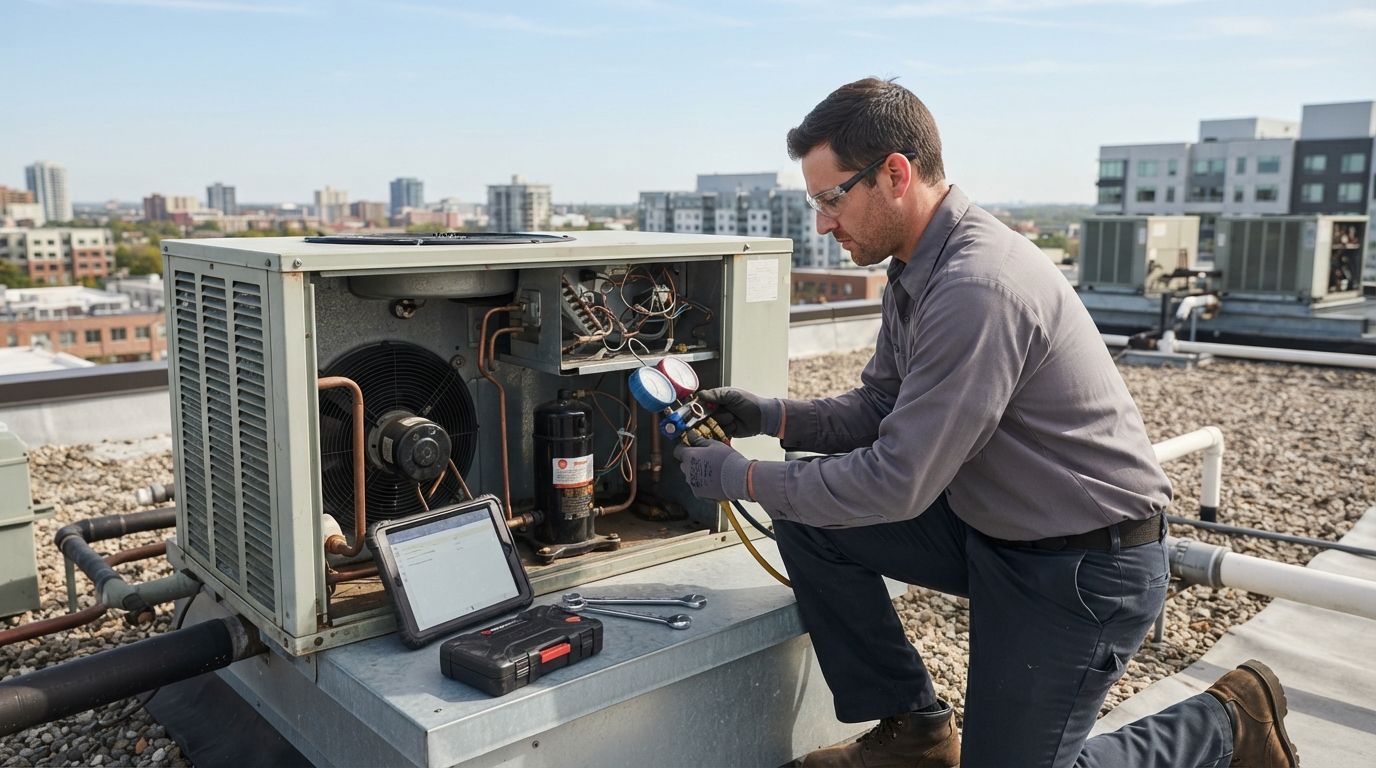
- Measure suction pressure, head pressure, and intermediate pressures across the refrigeration circuit using digital manifold gauges or low-loss probe sets.
- Calculate dynamic superheat at the evaporator outlet and compressor suction inlet; compare numbers against the metering device requirements (fixed orifice vs. thermostatic expansion valve).
- Calculate subcooling values at the condenser liquid line exit. Subcooling provides an accurate picture of the refrigerant liquid reserve sitting upstream of the expansion valve.
- Inspect the liquid line sight glass for continuous clear liquid flow; moisture indicators showing yellow or pink alert technicians to trace amounts of water contaminating the oil and refrigerant mixture.
- Check the pressure drop across the liquid line filter-drier using sensitive contact temperature probes or manifold taps; a drop exceeding 3 PSI indicates desiccant breakdown or trapped particulate inside the drier core.
- Execute a dedicated electronic refrigerant leak search across mechanical service valves, flare joints, Schrader cores, and brazed U-bends on coils using an infrared or heated-diode leak detector.
- Check compressor crankcase heaters for electrical continuity and proper temperature rise during standby cycles to stop off-cycle refrigerant migration into the compressor oil sump.
Federal regulations, specifically EPA Section 608 under the Clean Air Act, mandate strict leak rate thresholds and systematic documentation for commercial refrigeration and comfort cooling systems containing 50 or more pounds of ozone-depleting and high-GWP refrigerants. Quarterly leak checks provide the primary operational trail necessary to prove continuous regulatory compliance and avoid severe operational fines.
Economizers, Dampers, and Ventilation Control Validation
Economizers provide useful free cooling when outdoor enthalpy drops below indoor setpoints. Unfortunately, field studies show that more than 60% of commercial economizers are broken, jammed, or incorrectly configured. When outdoor dampers stick open in humid mid-summer conditions, mechanical cooling load jumps dramatically, overloading compressors and driving utility charges higher. If they stick shut, building spaces quickly suffer from poor air circulation and high indoor carbon dioxide concentrations.
- Inspect mechanical linkages, drive gears, damper blades, and jackshaft assemblies on outdoor, return, and relief air dampers for physical binding, play, or mechanical slippage.
- Lubricate damper linkage pivots and blade edge bearings using appropriate non-gumming synthetic lubricants.
- Check motorized damper actuator operation through its complete stroke from 0% to 100% using manual override switches or control system test commands.
- Calibrate outdoor air dry-bulb temperature and relative humidity sensors against calibrated reference meters to ensure economizer changeover logic triggers at the right thermal setpoint.
- Confirm minimum outdoor air damper positioning to ensure code-mandated indoor ventilation rates (governed by ASHRAE Standard 62.1) are continuously met without over-ventilating unconditioned outdoor air.
Annual HVAC Preventive Maintenance: Comprehensive Overhauls and Regulatory Compliance
Annual preventive maintenance tasks require deeper mechanical access, deliberate planning, and sometimes extended system downtime. Often scheduled during the seasonal shoulder months (early spring or late autumn), these annual overhauls look at the entire mechanical asset lifecycle. They include deep mechanical cleaning, electrical integrity audits, chemical water treatment analysis, safety testing, and performance testing designed to reset equipment tolerances for the upcoming operating year.
High-Voltage Electrical Distribution and Megohmmeter Auditing
Electrical failure remains a primary root cause of catastrophic compressor and large commercial motor losses. Annual electrical preventive maintenance focuses on identifying insulation breakdown, contact resistance, and harmonic issues before an arc fault destroys electrical enclosures.
- De-energize and lock out/tag out (LOTO) all primary power supplies serving the equipment; verify dead circuits using a properly rated multimeter.
- Inspect all primary motor contactors, disconnect switches, and auxiliary relays; replace contactor assemblies exhibiting deep pit formations, silver degradation, or excessive mechanical play.
- Check the tightness of all electrical terminations on circuit breakers, terminal strips, motor lugs, and compressor terminals; apply calibrated torque wrenches to match manufacturer torque specifications.
- Conduct infrared thermographic scanning across high-voltage switchgear, electrical distribution panels, and running drive electronics under normal operating load to identify loose lugs, phase load imbalances, or internal switch defects.
- Perform insulation resistance testing (megohmmeter tests) on compressor motor windings, supply fan motor windings, and circulating pump motors to identify dielectric insulation degradation.
A standard megger test applies high-voltage DC (typically 500V or 1,000V) between the motor winding conductors and the grounded motor frame. When insulation resistance values fall near or below 1 to 5 megohms, it indicates severe thermal degradation, moisture intrusion, or chemical contamination of the winding insulation. Catching this winding decay early allows facilities to plan an orderly motor rewinding or replacement during planned downtime, avoiding a catastrophic locked-rotor short circuit that can acid-contaminate an entire refrigeration circuit.
Hydronic Loops, Chillers, Boilers, and Closed-Loop Systems
For facilities relying on centralized hydronic systems—such as water-cooled chillers, cooling towers, gas-fired boilers, and distribution loops—annual maintenance expands considerably to include fluid mechanics and chemical analysis.
- Mechanically brush tube sheets and clean internal copper tubes within shell-and-tube heat exchangers, evaporators, and water-cooled condenser barrels to remove calcium carbonate scale, slime, and sedimentation.
- Flush and service open-loop cooling towers: scrub the basin, flush spray nozzles, inspect the drift eliminators, check gearboxes for oil contamination, and verify cooling tower fan vibration switches.
- Test closed-loop hydronic systems for glycol concentration using a refractometer, ensuring freeze-point and burst-point protection metrics align with local environmental parameters.
- Pull representative hydronic loop water samples to test for corrosion inhibitors (nitrites, molybdates), pH stability, dissolved solids, and iron content to prevent pipe erosion and inner tube pitting.
- Verify compliance with localized health and environmental standards, such as the ANSI/ASHRAE Standard 188 framework, to prevent Legionella colonization in cooling towers, evaporative condensers, and decorative fluid features.
- Inspect, test, and recertify hydronic relief valves and primary backflow preventers according to regional plumbing and boiler safety codes.
Scale formation inside water-cooled condenser tubes acts as a stubborn thermal barrier. Just 0.036 inches of mineral scale buildup inside a chiller barrel increases energy usage by roughly 30% for the exact same cooling output, driving up seasonal utility bills.
Combustion Systems and Heating Exchanger Safety Audits
During the late summer and early fall maintenance window, attention turns toward gas-fired heating units, packaged gas-electric rooftops, and hydronic heating plants. Heating failures can risk building freeze-ups and serious life-safety hazards, including carbon monoxide leaks and combustion fuel explosions.
- Inspect heat exchangers for metal fatigue, thermal stress cracks, rust holes, and weld separations using high-intensity inspection cameras or specialized boroscopes.
- Clean and adjust burner assemblies, clear out carryover ports, and inspect pilot assemblies or hot-surface igniters for resistance drift.
- Measure fuel gas supply pressure and manifold gas pressure during steady-state firing to confirm fuel delivery stays within manufacturer specifications.
- Conduct an industrial flue gas combustion analysis using an electronic combustion analyzer; record flue gas temperature, oxygen (O2) percentage, carbon dioxide (CO2) percentage, and carbon monoxide (CO) parts per million (PPM) to verify clean, efficient combustion.
- Test flame rollout switches, high-limit thermal switches, combustion air proving pressure switches, and draft inducer fan assemblies to ensure safety interlocks engage without delay.
Even microscopic cracks in an air handler gas heat exchanger can introduce combustion gases directly into the building supply air stream. Thorough annual inspections and combustion efficiency tests are critical to confirm life-safety systems work reliably before the first winter heating call arrives.
Air Distribution, Dampers, and Air Balance Audits
Conditioned air must reach design spaces in the correct volumes. Over time, building layouts change, duct joints separate, pneumatic and digital actuators drift, and system air balance falls out of specification.
- Inspect primary duct plenums, flexible duct connections, and canvas transitions for air leakage, physical tears, and acoustic lining breakdown.
- Inspect and test life-safety fire and smoke dampers across building firewall penetrations; verify thermal fusible links are intact and test motorized smoke damper cycling according to NFPA 90A and NFPA 105 mandates.
- Calibrate supply, return, and exhaust variable air volume (VAV) terminal units, verifying terminal controller airflow sensor pick-up tubes are clear of dust.
- Compare total operating system airflow (CFM) against original engineering balance reports to verify primary supply fans are delivering design air volumes to the building envelope.
Operationalizing HVAC Maintenance: Moving from Spreadsheets to Modern CMMS Execution
Even the most thorough preventive maintenance checklist is practically useless if it only lives on paper clipboards, laminated checklists, or buried inside a facility manager's desktop spreadsheet. Static spreadsheets cannot trigger dynamic schedules based on run-hours, cannot instantly pull historical compressor amp draws for a field technician standing on a wet roof, and cannot track recurring failure patterns across assets. When maintenance plans rely on manual tracking, preventive maintenance checklists are quickly skipped whenever operations get busy.
Modern maintenance teams rely on centralized platforms like MaintainNow to transform routine maintenance checklists into structured, trackable work processes. Instead of manually remembering to schedule a quarterly condenser coil cleaning, the CMMS generates the work order automatically based on real-world elapsed time, ambient seasonal shifts, or automated runtime triggers pulled directly from equipment telemetry.
Technicians on site access their checklist items, enter motor amperages, capture digital photos of worn belt surfaces, log refrigerant subcooling figures, and upload combustion analysis readings directly from their smartphones via the MaintainNow application.
Moving to this digital approach directly tackles common maintenance roadblocks:
- Eliminating wasted technician transit time and unnecessary trips back to the maintenance office to fetch paper equipment manuals or historical service sheets.
- Maintaining clear asset histories that link every component failure, electrical reading, and work order directly to the parent HVAC unit's record.
- Making inventory tracking seamless by linking replacement V-belts, pleat filters, contactors, and crankcase heaters directly to scheduled tasks, so technicians have the right parts on their trucks before heading out on service calls.
- Standardizing compliance tracking for audits by maintaining digital logs of refrigerant usage, fire damper certifications, and cooling tower cleanings.
Operating with modern tools also enables facility managers to transition smoothly from pure time-based maintenance to condition-based predictive maintenance. By pairing regular preventive routines with real-time condition monitoring—such as continuous IoT vibration sensors on critical cooling tower fan bearings or automated supply line temperature probes—facility managers catch asset degradation at its earliest stages. Technicians can then intervene before an asset experiences severe physical damage or high-pressure cutouts.
When operations teams use structured maintenance data, maintenance leadership gains clear, actionable insight into key operational KPIs. Instead of guessing where their budget goes, managers can track Mean Time Between Failures (MTBF), Mean Time to Repair (MTTR), Overall Preventive Maintenance Compliance (PMP), and total operational maintenance costs broken down by specific asset classes.
Comparing repair costs directly against an asset's replacement asset value (RAV) gives teams the objective data they need to make confident, business-backed repair-versus-replace decisions.
Preventive Maintenance Schedule Summary
Conclusion
Commercial and industrial HVAC systems are complex mechanical networks that demand steady, structured technical care. Relying on an unstructured, run-to-failure approach is a losing strategy that drives up energy costs, leads to frequent emergency repairs, causes operational downtime, and burns out maintenance personnel. By running a disciplined preventive maintenance program structured across monthly, quarterly, and annual horizons, facility teams protect heat transfer efficiency, keep mechanical equipment running dependably, and extend the operating life of expensive assets.
Moving away from reactive maintenance chaos requires more than just knowing what technical tasks to run. It requires the operational tools to enforce those routines across your entire team.
Implementing a modern, mobile CMMS platform like MaintainNow gives technicians clear, structured checklists right in the field while giving maintenance leaders real-time visibility into equipment health, asset lifecycle costs, and operational compliance.
Equipping your maintenance department with the right digital platform turns routine HVAC maintenance into a predictable, repeatable competitive advantage that cuts unexpected downtime and delivers real bottom-line value to your organization.
Ready to implement these maintenance strategies?
See how MaintainNow CMMS can help you achieve these results and transform your maintenance operations.
Download the Mobile App:


✅ No credit card required • ✅ 30-day money-back guarantee • ✅ Setup in under 24 hours